
1 day ago · Expository essay example with author Example of library paper research long dissertation synonym single parent adoption argumentative essay library paper Example of research. The most important thing in life is to be successful essay case study environment topics. Essay on watermelon in hindi for class 2 · They describe, analyze, and/or evaluate information found in primary sources. By repackaging information, secondary sources make information more accessible. A few examples of secondary sources are books, journal and magazine articles, encyclopedias, dictionaries, handbooks, periodical indexes, and reviews, etc blogger.com ️ The British Library, Research Paper Example from students accepted to Harvard, Stanford, and other elite schools
Picking Research Topics in Library and Information Science
This sample Libraries Research Paper is published for educational and informational purposes only. Free research papers are not written by our writers, they are contributed by users, so we are not responsible for the content of this free sample paper. If you want to buy a high quality research paper on history topics at affordable price please use custom research paper writing services. Libraries contribute significantly to the advancement of civilization, library research paper example.
Since humans began to record ideas and information for later recall, collections of records kept throughout the world for five thousand years, consisting of a few items or millions, have been important in preserving the memory of society. Although each period and locality is distinct, many issues of record keeping, such as preservation and classification, are the same.
Libraries are collections of graphic records, organized for accessibility and maintained for the benefit of individuals in the community they serve. Libraries generally consist of portable physical entities books made of durable materials that contain written and artistic notations of reasonable length. When collections consist primarily of records of institutions and individuals that are organically related— that is, they share a common creator, subject or purpose, as opposed to isolated, random artifacts— and maintained for access because of their continuing value, they are referred to as archives, library research paper example.
When they consist of creative texts dealing with cultural and historical themes, they are called libraries. After human beings began to speak, the need arose to preserve orally transmitted information.
Although visible marks of any kind could record some ideas, in order to transmit information reliably from one generation to another and ultimately from one culture and era to another, a system needed to be developed whereby those marks would be conventional enough to convey complex ideas over time—that is, the marks needed to be somewhat standardized in order to be understood by others. After several centuries of experimentation with pictographic symbols and multishaped tokens and their representations, writing appeared in both Mesopotamia and Egypt sometime before about BCE.
Early collections of a few clay tablets or papyrus rolls were likely to be primarily archival repositories, but within centuries, books that included religious, library research paper example, historical, literary, and scientific texts appeared and true libraries began, often in conjunction library research paper example archives. Many early library collections were housed in temples, where scribes produced and maintained them.
These temple libraries were established throughout the Fertile Crescent and in Egypt, library research paper example, India, and China. Caretakers of these collections were faced with problems of preservation, classification, and physical arrangement. Among the oldest library archives is the collection at Ebla, a city in northwestern Syria dating to at least the middle of the third millennium BCE, which contained more than fifteen thousand tablets, including a variety of archival records, as well as linguistic reference works, chronologies, gazetteers, manuals dealing with the physical world, and religious and literary works.
Similar repositories existed at Mari in northwestern Iraq and Boghazkoy in modern Turkey. Though the physical evidence is not as abundant in Egypt, archival collections also appeared there during this period, according to inscriptions on temple walls and surviving scrolls.
While small collections were found throughout the Fertile Crescent, the library of the Assyrian Assurbanipal reached its peak in Nineveh in northern Iraq in the seventh century BCE. Although the library was buried in the destruction of the Babylonians in BCE, the British excavated it in the nineteenth century and much of the collection is now in the British Museum.
Evidence exists that the Mycenaean civilization of the late second century BCE was the heir of developing library processes and technology, library research paper example it was only after about BCE that Greek libraries and archival repositories become common.
Focusing on epics composed much earlier, by the sixth century BCE the movement toward wider reading and collecting was well underway.
In the late fourth century BCE, Hellenic civilization promoted broader inquiry and utilization of the written word, which resulted in a rising volume of both scholarly and popular works.
The great Alexandrian Library in Egypt, founded about BCE, became a repository for materials from all over the known world and was a center for scholarship and original research. Along with smaller libraries at Pergamon and Athens, it would continue these functions for several centuries, until its decline in the fourth to seventh centuries CE, library research paper example. As heir to the Greek tradition, Rome recognized the value of the library, library research paper example, and through confiscated books and new copying began to build libraries of its own.
The emperors Augustus, Tiberius, Vespasian, Trajan, and Hadrian established libraries in Rome in the first and second centuries CE. These collections at Rome, which typically contained separate rooms for Greek and Latin books, and similar ones in the provinces, were housed in temple-like buildings and later in public baths. They were widely used and considered symbols of civilization.
During the early centuries of the library research paper example era, the form of the book changed from the scroll or roll to the codex, the form of book we know today.
This change in format enabled texts of greater length to be bound together as a unit, enhancing portability and ease of use. During this period, recognized collections of writings developed, including major works of mythology, library research paper example, history, philosophy, and religion. For example, the Bible of the Christians, consisting of approximately sixty-six books, written over a period of more than a millennium, assumed its form during this period and was itself a kind of library.
Christian libraries, such as the one at Caesarea in Palestine c. The weakening of central imperial authority and barbarian threats, as well as the rise of organized Christianity and the early monastic movement, brought challenges and changes to the cultural environment of the late Roman Empire. The decentralization of library research paper example and influence encouraged local manifestations of governmental and church institutions, including libraries, which spread to the farthest reaches of the empire.
After aboutwhen in the Western portion of the empire the church had assumed many of the stabilizing institutions of society, scholarly efforts centered largely on library research paper example old texts and keeping existing learning alive by writing texts. Libraries continued to flourish at Constantinople in patriarchal and academic libraries until the fifteenth century.
In Asia, books and libraries grew in significance in the period of antiquity. The Aryans, who brought Vedic traditions to South Asia about BCE, supplanted the Harappan culture already established in the Indus Valley. They in turn provided the environment for the rise of Jainism and Buddhism in the sixth century BCE—each religious tradition also developed its own canon of religious writings.
Like Judaism and Christianity, which took root in the centuries spanning the divide of the eras BCE and CE, Jainism and Buddhism had significant written literature.
Their extensive texts joined a developing archival system to produce library collections maintained by individual societies. The experience of the Han dynasty in China BCE— CE with the expansion of Buddhism was in some ways similar to the challenge posed to the later Roman Empire by the expansion of Christianity with respect to the consolidation of governmental authority and the preservation of cultural heritage.
In particular, the Han dynasty experienced the proliferation of Buddhist texts, sometimes without official sanction. Meanwhile, library research paper example, Han emperors encouraged the compilation and editing of Confucian writings and a variety of other texts, including those in the arts and sciences, as well as the maintenance of such collections.
The invention of library research paper example and the extensive use of block printing in this period also expanded the production of books and increased the number of collections available to governmental and cultural institutions, and to individuals. These works were frequently copied and collections were maintained in monasteries and other protected sites. The Cave of a Thousand Buddhas near Dunhuang in Chinese Turkestan housed one such collection, which had been developed about and was discovered as recently as This famous cache of texts was collected in the years prior to the cave being sealed, aboutwhich invaders threatened.
It was discovered by the British archaeologist Aurel Stein and was dispersed to several repositories in Asia and Europe. Eventually massive collections of these works were reproduced by Chinese imperial authorities for access and for preservation.
Two major hand-written encyclopedias were produced—one between and more than eleven thousand volumes and another between and thirty-six thousand volumes. The latter was produced in seven copies of which two are still largely extant. The works not selected for inclusion were subsequently lost to succeeding generations.
The writings of Confucius, Buddha, and their followers were brought to Japan and Korea in the sixth and seventh centuries CE, and schools, books, and libraries soon followed. While the arts of publishing flourished in Asia and monks and court officials preserved materials as best they could in Europe, the rise of Islam, beginning in the seventh century, formed a link between East and West through its growing network of scholarship and commerce.
The librarians and library research paper example of this period began to promote a cross-pollination of cultures, languages, and traditions. As Muslims translated Greek and Latin manuscripts into Arabic and produced their own literature, they also soon introduced papermaking from China library research paper example their domain to Andalusian Spain. By the ninth and tenth centuries major urban centers like Baghdad and Cairo enjoyed numerous libraries—many of which were open to the public—that supported institutions of learning culture such as schools, mosques, and palaces.
By searching existing collections and employing copyists and binders, Caliph al-Hakim II —for example, built an extraordinary library in Cordoba with aboutvolumes—the catalogue itself consumed forty-four volumes, library research paper example.
Some scholars suggest that the intellectual activity in the great mosque in Cordoba, which attracted scholars and students from across the Near East and Western Europe, served as a catalyst for the establishment of new universities and the transmission of important knowledge from East to West—of papermaking, for example.
Library research paper example the twelfth and thirteenth centuries and afterward, warfare from within the Islamic regions and from invaders resulted in the decline and loss of many of the great collections, library research paper example. In many cases only individual items have survived. The barbarian invasions of the Roman Empire, including Rome itself, in the fifth and sixth centuries, had different results in the East and the West.
In the region governed by Constantinople Byzantium, today Istanbul the institutions of state and church, drawing on Greek cultural foundations, continued relatively intact until the coming of the Persian and Islamic conflicts from the middle of the first millennium.
Substantial libraries remained open in the capital and smaller ones in major cities until the Fourth Crusade and the capitulation to the Turks in Though libraries were significant in the early Eastern Empire, they had declined considerably by its end. In contrast, in the early medieval period — libraries in Western Europe suffered from the fragmentation of the Roman Empire that brought chaos and instability.
In the Library research paper example, monastic libraries, stimulated generally by the growth of the Benedictine order and the missionary activity of Irish and Anglo-Saxon monks, began to flourish widely, so that by the time of Charlemagne c. Most of these libraries contained fewer than several hundred volumes.
Cathedral libraries, which supported schools and scriptoria, grew slowly and began to serve clergy and civil servants not associated with a cloister.
Some of these schools, such as the one in Paris, were antecedents of universities that appeared in the twelfth century; others, such as Chartres and York, were not, library research paper example.
Later, other orders joined in copying activities. The coming of the first Western European universities resulted in the formation of libraries with broader responsibilities than those of monasteries and archival repositories. Beginning with the early models of Padua, Salerno, Bologna, Paris, Oxford, and Cambridge, universities proliferated in Europe until, by the sixteenth century, they had become symbols of regional pride. Most of these institutions had central libraries, library research paper example, often built up by donations and under the custody of one of the masters, library research paper example.
The Bodleian Library at Oxford and the library of Trinity College, Dublin, date from the early seventeenth century. At Oxford, Cambridge, and elsewhere, library research paper example, individual colleges maintained separate and independent collections that only later, if ever, were integrated into the general collection.
Until the coming of moveable-type printing in the fifteenth century, books and archives were not always easily distinguished and may have been housed together. Within fifty years of the appearance of the moveable-type printing that Johannes Gutenberg developed aboutthe presses of Europe increased production from a trickle to a flood of new scholarship and creative works, library research paper example, as well as of more accessible editions of the classic works from the ancient and medieval periods.
These publications, possiblytitles bywere both scholarly and popular works and contributed to creating and preserving the new ideas introduced by the Renaissance. While elite collectors library research paper example prefer manuscripts and lavishly illustrated volumes for some time to come, the less expensive and more portable printed books found an enthusiastic market—for example, in libraries and with collectors who would ultimately be benefactors of libraries.
This new category of book collectors who established personal libraries included members of the noble and upper classes, both those with hereditary titles and those who had accumulated wealth through commerce, manufacturing, and banking. They typified the enthusiastic response of library research paper example human spirit to the new ideas and knowledge that encouraged the building of libraries.
Libraries became the possession not only of the privileged segments of society, but also, eventually, of the middle classes. Early examples of this kind of princely library include that of Matthias Corvinus, king of Hungary —whose magnificent collection was dispersed by the invading Turks in the early sixteenth century. The Medici family in Florence exemplifies the merchant class; among the Medici projects was its great library, now the Laurentian Library, one of the first modern libraries to have its own building Other wealthy families competed in building library and art collections that brought them esteem.
The Papal library at the Vatican, which dates its modern founding to Nicholas V and Sixtus IV in the fifteenth and sixteenth centuries, is another good example. Some of these collections grew into their own institutions; others merged through sale or bequest into other collections. In the sixteenth century, libraries were increasingly attainable by the middle class through the proliferation of popular printed reading material.
Books became cheaper and more widely available, and thus were collected by more people—a trend that has accelerated to the present. Political, religious, and social groups all tried to exploit the potential for promoting their messages; the Reformation and the civil conflicts accompanying it unleashed the power of political pamphlets and books.
The Lutheran Reformers promoted education and reading as a public good that demanded public support, which made libraries even more significant. The Jesuits likewise considered a serious education, requiring books and libraries, to be essential in promoting the Catholic faith.
Beginning in the early eighteenth century the Society for Propagating Christian Knowledge SPCK and the Society for the Propagation of the Gospel in Foreign Parts SPG published and distributed Protestant religious and educational materials throughout the British Empire, and through the influence of the Reverend Thomas Bray — they established several kinds of libraries for popular and clergy use, notably in England and the British colonies in America.
My Step by Step Guide to Writing a Research Paper
, time: 9:15Library Research Paper: Example & Writing Guide []
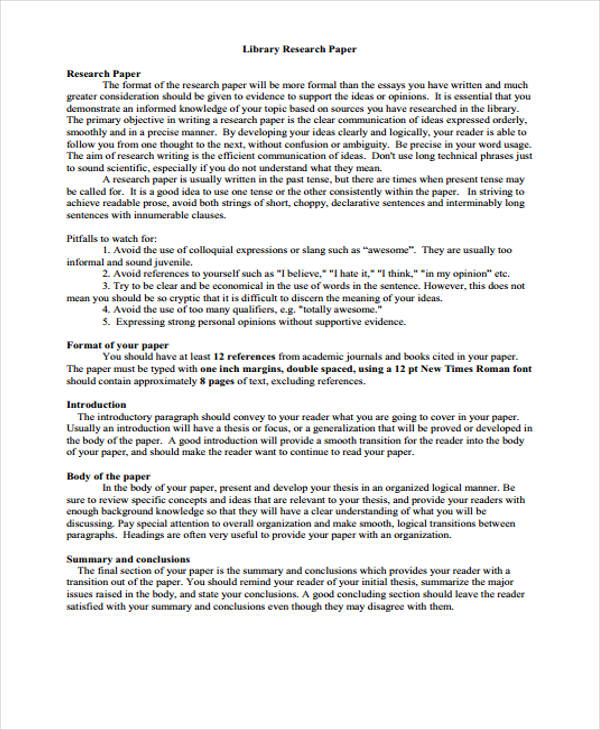
Example of library research paper - Free Course Work - Because We are Leaders. 10 days - Readiness of your work!! Humanitarian Themes - Any complexity and volume!!!! · They describe, analyze, and/or evaluate information found in primary sources. By repackaging information, secondary sources make information more accessible. A few examples of secondary sources are books, journal and magazine articles, encyclopedias, dictionaries, handbooks, periodical indexes, and reviews, etc demonstrate an informed knowledge of your topic based on sources you have researched in the library. The primary objective in writing a research paper is the clear communication of ideas expressed orderly, smoothly and in a precise manner. By developing your ideas clearly and logically, your reader is able to follow you from one thought to the next, without confusion or File Size: 48KB

No comments:
Post a Comment